
Twenty years ago, a new service station was planned for the M5 outside Gloucester. But this was to be unlike any other.
Residents on a nearby social housing estate got onto the idea early, discussing how to turn the service station into an asset for the local community; something that would bring jobs and prosperity into their community. They set up Gloucestershire Gateway Trust, won the support of Westmorland, the family business already running a service station in Cumbria, and formed a partnership to develop the new service stations.
The services were opened seven years later by King Charles.
When motorists stop to refuel their cars and bellies, up to 3p of every £1 spend on non-fuel sales goes to the local trust. Jobs have been taken up by local people, with initiatives to help those experiencing barriers to work such as disability or learning difficulties; community partners support staff and volunteers with wellbeing, debt advice and other services; and shops sell produce from local businesses rather than multionational chains.
In the years since it was opened, more than £4 million has been skimmed off the motorway and ploughed into a deprived community in Gloucester, and much more economic value has flowed to local workers and businesses.
Power to the people
This set up at Gloucester is conceptually similar to ‘shared ownership’ in the Government’s Local Power Plan.
That plan aims not only to create a secure, affordable and zero carbon energy system, but to do so while restoring pride in communities, delivering energy security and creating good local jobs and growth.
As Miliband writes in his foreword, ‘local and community energy is at the heart of our government’s vision‘.
To achieve that, the plan proposes a familiar model of direct investment into community energy organisations, with £1bn of loans, grants and advice to grow this sector from the bottom up.
But it also proposes co-ownership models, in which community organisations can become partners and co-owners in large-scale energy projects developed by the private sector and Great British Energy. Communities will have a stake in the energy infrastructure, and be able to skim off a portion of the revenue in a similar way to the Gloucester Gateway Trust.
These models make it much easier for communities to get a first step into the energy system and enable them to be party to large projects they couldn’t possibly do alone. The government will also consult on making these models mandatory for private sector-led schemes, guaranteeing local people a right and an ownership stake in the energy system.
This diagram (rather small) captures this, in which community ownership is integrated into the overall energy strategy, rather than being a parallel and niche activity.
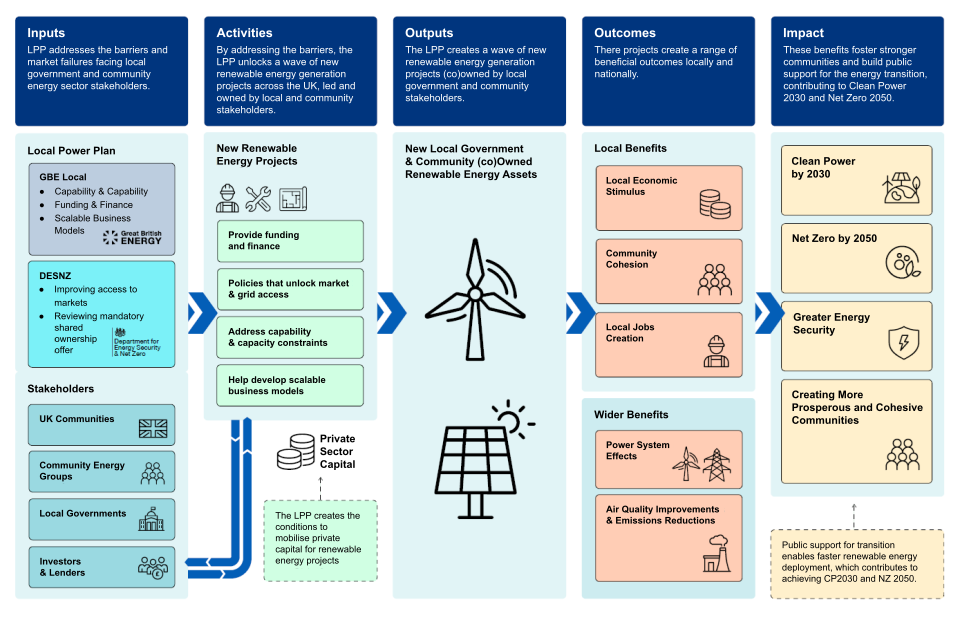
The reach and impact of this strategy could be further enhanced by the development of more intermediary infrastructure. I wrote three years ago about the multifaceted strategy employed by the co-operative sector in Northern Italy, which included the creation of consortia and intermediaries to pool resources and achieve economies of scale, and financial institutions that open the door to private and public capital.
One such innovation in England was CORE, set up by Power to Change, Better Society Capital and Finance Earth. This created new financial and delivery intermediaries to acquire six large solar farms, and then transition them into community ownership. It was able to operate at a speed and scale that no community energy group could do individually.
A strategy that included an intention to develop this kind of market infrastructure, targeted at knitting together the shared ownership models, could turbocharge community ownership of energy.
Towards a foundational strategy for community ownership
Imagine if the Department for Transport applied Miliband’s ambition to the road infrastructure. If every new service station was mandated to form a partnership along the lines of Gloucester Services. Or railways, with every railway station shop and concession, every car park, generating local jobs and wealth and opening opportunities for community (co)ownership.
What if this logic was applied to other parts of the foundational economy?
If the well-established partnership model between community land trusts and housing associations was incentivised or even mandated, so local communities could lead on the development of new social housing which they then steward and protect in perpetuity? If this were extended to all large-scale development and regeneration, giving communities agency and an ownership stake in development built by the public and private sector, as has happened in cases like Kennett Garden Village, with CLTs capturing land value and decommodifying the land?
If work to pioneer Local Property Partnership for high streets became the new model for high street revitalisation and regeneration? If partnerships were routinely created by local/combined authorities, with an explicit tactic to bring more land and buildings into community and public ownership?
If the shake-up of the water system saw communities own, or co-own, or have a stake in the vast land holdings of water companies? What if some of United Utilities’ 56,000 hectares of land in the North West, owned to protect the quality of water entering reservoirs, was owned or co-owned by communities who could ensure that land also helped to restore nature, reduce flood risk, support agroecology, support local jobs, and so on? And if a percentage of the income for the water company was reinvested in those communities?
If Defra were charged with redesigning agricultural and land subsidies, and redesigning systems like Biodiversity Net Gain, and intervening to shape natural capital markets, so that community ownership of farmland, forestry and wild land was incentivised? Perhaps inspired by pioneers like Middle Marches CLT, which is part of a new national nature reserve, is accredited to take on conservation covenants and is tapping into Defra agricultural payments.
Wouldn’t that be a community ownership strategy that lays the foundations for local renewal on a national scale?
The sector niche
I ask the question because the narrative around community ownership in England, and Wales, is dominated by a much smaller ambition. A framing that describes ‘national renewal’ in much smaller terms.
Locality and Power to Change have just published an excellent piece of research on how to best reboot the Community Ownership Fund.
It covers lots of good ground. It makes a strong case for the impact of community ownership of community spaces. It documents some of the lessons we can learn from the recent Community Ownership Fund.
But it’s vision is small. Tiny, even.
It frames the potential of community ownership from the perspective of a small local community organisation hoping to acquire one or more assets, perhaps using the Community Right to Buy, and looks at the barriers to success. If I could adopt the language of the Local Power Plan to critique the research, it leaves the door to community ownership shut to most places, and fails to unlock opportunities for those community organisations to be party to large-scale economic activity.
It even namechecks, and explicitly rejects, Homes England, which wields £39bn of grant capital, £16bn National Housing Bank and £5bn of capital financial transactions. Why? Because the agency ‘relates to housing and regeneration, not community buildings’. But this is both incorrect (because Homes England can and does support mixed-asset development), peculiar (because both the report authors have been involved in community-led housing work and surely housing is a community asset), and exasperating (because the CLT and Cohousing networks are actively talking with senior leaders in Homes England about integrating community models into its practices).
And so the scale of their vision is that over five years, £1bn of public subsidy might lever in £1bn of private finance to bring ‘several thousand’ assets coming into community ownership.
That equates to something like 0.01% of the English economy (GVA) in that period, and would probably result in a smaller proportion of fixed assets. It’s a strategy for niche growth, not national renewal.
Bonnie Scotland
The Locality and Power to Change research refers to Scotland, both as an inspiration for the Community Right to Buy and a comparator for public funding.
But Scotland also shows us a more expansive vision of community ownership. To take three examples,
Official statistics indicate that around 3% of land in the country is community owned.
The Community Wealth Building (Scotland) Act 2026 requires councils, health boards and other public bodies to use their spending power, policy levers and land and assets to — among other things — promote community ownership across the board.
The National Planning Framework 4 makes community wealth building a core principle. It gives positive weight to any development that results in community ownership, incentivising landowners and developers to partner with community organisations.
All of this is underpinned by a robust legal definition of community ownership — one that exists in England in the legal definition of ‘community land trust’ but that is overlooked by a sector content to talk loosely of non-democratic, non-accountable charities and social enterprises being forms of community ownership.
Scotland isn’t a utopia. For example, as Andy Wightman has documented, despite an active land reform agenda the concentration of land ownership has got worse in the last twenty years, and the growth of community ownership has stalled somewhat as the focus has shifted away from land reform towards a narrower vision of saving community spaces.
The productive community: a hyperlocal Manchesterism?
There are many policy hooks which you could hang a genuinely ambitious community ownership agenda off, especially during a summer with change in the air.
But the Mainstream think tank’s Productive State framework, dubbed ‘Manchesterism’, is a particularly good fit.
In this framework, public control is reasserted in key parts of the economy that underpin prosperity — such as energy, housing and transport — through direct engagement in public investment, provision, ownership and coordination.
Public ownership plays a key role in their framework, but with a more diverse set of institutional forms than nationalisation. For them, public ownership can encompass municipal enterprise, community ownership, co-operatives and not-for-profit service providers. They propose a ‘form follows function’, or ‘form follows the nature of the good’, approach to determining the appropriate institutional form.
This echoes the framework in the Local Power Plan. The state directly engages through investment, national ownership and coordination in the energy system, and drives a more diverse set of institutional and ownership arrangements, with the potential that shared ownership with communities becomes the default in every energy project. It creates intermediaries and institutions that open the door for community organisations to significant levels of private and public capital.
The same framework could be applied elsewhere. For example, Homes England could be charged with incorporating community-led development and community ownership into every project it invests in, leads on or coordinates; and to ensure all public land it owns is transferred into either municipal or community ownership.
In this framework, a community or place-based lens would see the Productive State looking at the flows of capital through a neighbourhood and either putting the local community in control of much of it, or enabling them to partly direct the flow and generate/siphon off some of the benefit. Like codesigning the service station to create a more inclusive jobs opportunity and skimming some of the revenue off motorists on the M5.
The case for this can then be made by expanding on Locality and Power to Change’s case for community ownership of community centres, incorporating an analysis of community wealth. But while the strategy might incorporate investment of circa £1bn over five years to grow bottom-up capacity, its main levers would be fundamentally different, as in the Local Power Plan.
That is, the Productive State would be building productive capacity in more socially cohesive communities by wiring community agency and ownership into private/public sector partnerships to deliver the foundations of a healthy economy. It would prioritise provision over extraction, democratic accountability over shareholder primacy, and long-term stewardship over short-term yield.
Could this be the key to local renewal on a national scale?

